Dia Tren Traditional Do Paper Village – Where the Nung An “Write” Memories on Every Sheet
In a peaceful valley among the mountains and forests of Quang Uyen, stilt houses with yin-yang tiled roofs nestle beside rice fields. The steady thud of wooden mallets pounding bark echoes from kitchens, while thin sheets of paper dry on earthen walls in the mountain sun and breeze. This is Dia Tren, a traditional do paper-making village of the Nung An, where every sheet is made entirely by hand from forest bark, using methods passed down through generations.
Where Is the Traditional Do Paper Village?
The village is in Dia Tren Hamlet. It was formerly part of Phuc Sen Commune in the former Quang Hoa District and is now part of Quang Uyen Commune following the 2025 administrative reorganization. Since July 2025, the new Quang Uyen Commune has comprised Quang Uyen Town and the former communes of Phi Hai, Phuc Sen and Chi Thao.
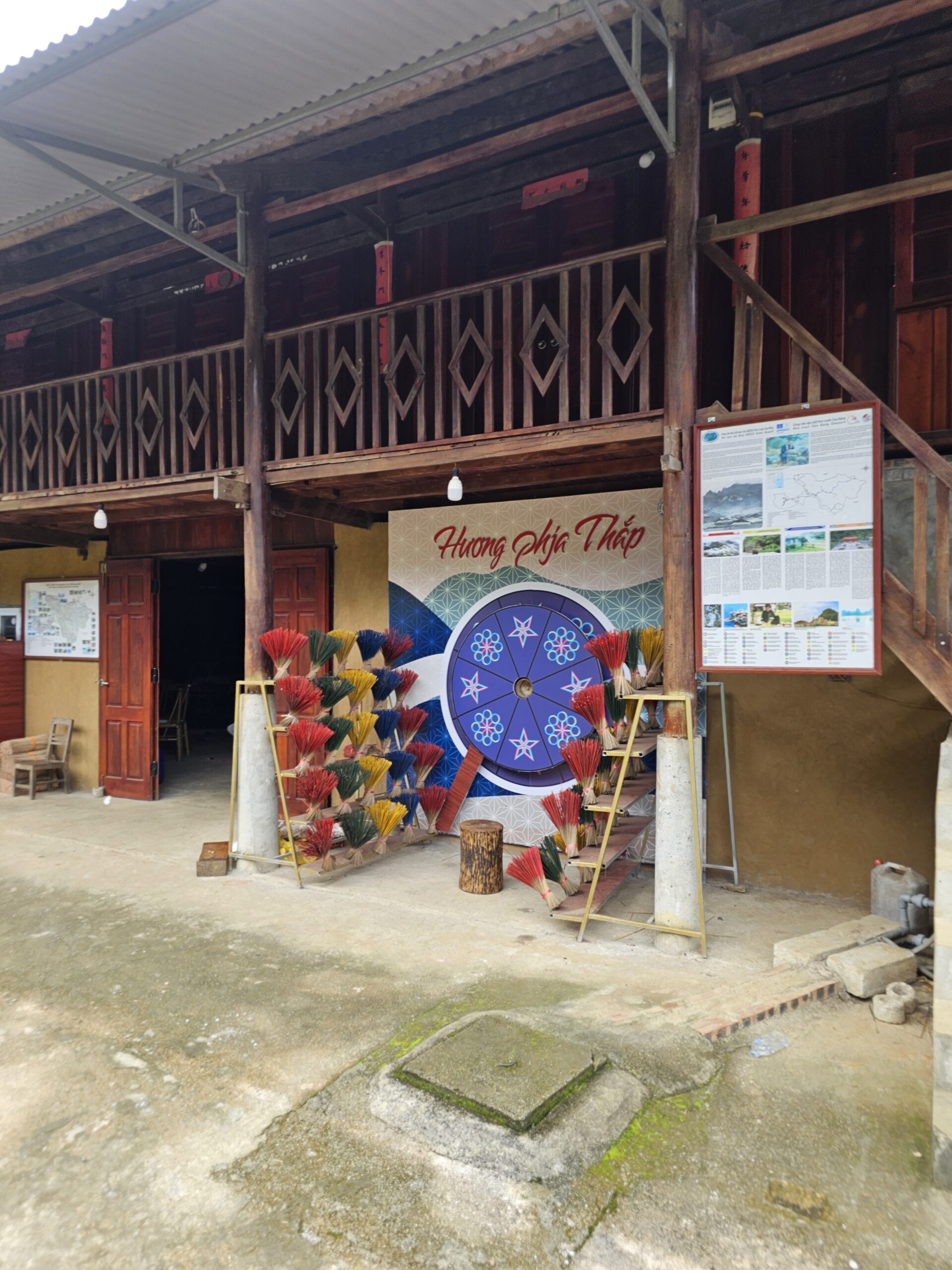
Dia Tren lies deep in a valley surrounded by rice fields, mountains and forests. It shares a commune with Phia Thap Incense Village. The village has been included on the eastern travel route through the UNESCO Non Nuoc Cao Bang Global Geopark.
Do Paper in Nung An Life
Do paper is part of Nung An life from birth to death. According to artisan Nong Thi Kinh, Nung An families need the paper from the moment a child is born, using it for the one-month celebration. As children grow up, ritual specialists use it to record auspicious dates for weddings and the cap sac initiation ceremony. It is also made into votive offerings to honor the dead.
Do paper is also used for record-keeping, writing in Han Nom, decorating homes and honoring ancestors during festivals and Tet. Each sheet is more than a handmade product; it is part of the community’s spiritual life.
Dia Tren Hamlet has around 64 households, more than 40 of which still make traditional do paper.
From May Sla Bark to Smooth Paper
The main raw material is bark from the may sla tree, which grows wild on rocky mountain slopes and produces smooth, strong, durable paper. The bark can be harvested when the tree is about one to two years old.
Each year, from around February to July, villagers head into the forest to strip bark from may sla trees. Nothing goes to waste: the trunks are used for firewood, and the leaves feed buffalo and cattle.
The Handmade Paper-Making Process
The process has remained largely unchanged for generations, with no machinery or industrial chemicals:
1. Preparing the bark: The bark is boiled for about two hours until soft. Once cool, the maker removes the rough, dark outer layer, keeping only the white inner bark. If it is not needed right away, the white bark is dried and stored above the kitchen hearth for use throughout the year.
2. Simmering with lime: To make paper, the white bark is soaked until soft, then mixed with slaked lime and simmered for about two to three hours. The lime helps break down the bark and whiten the pulp.
3. Soaking in a stream: The bark is rinsed, tied into bundles and soaked in a stream or irrigation channel for about a day to remove the sap.
4. Pounding into pulp: The bark is brought home and pounded with a large wooden mallet for about an hour until it becomes a fine pulp.
5. Mixing the pulp: The pulp is added to a water trough, stirred until smooth and mixed with a mucilaginous substance from a forest plant known locally as Khuoi Hao to help bind the fibers.
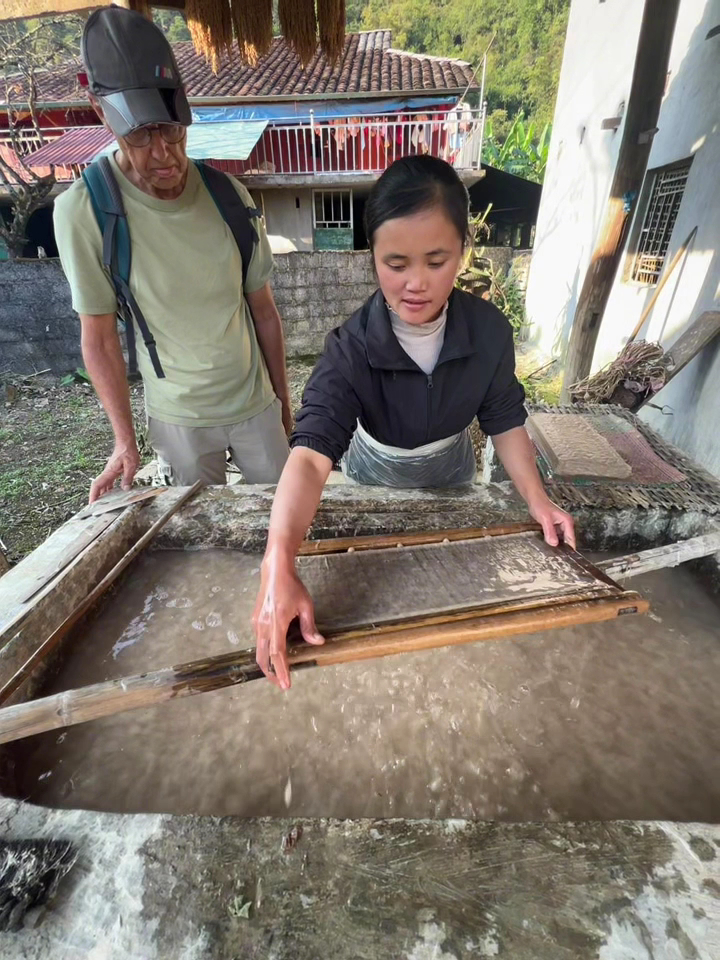
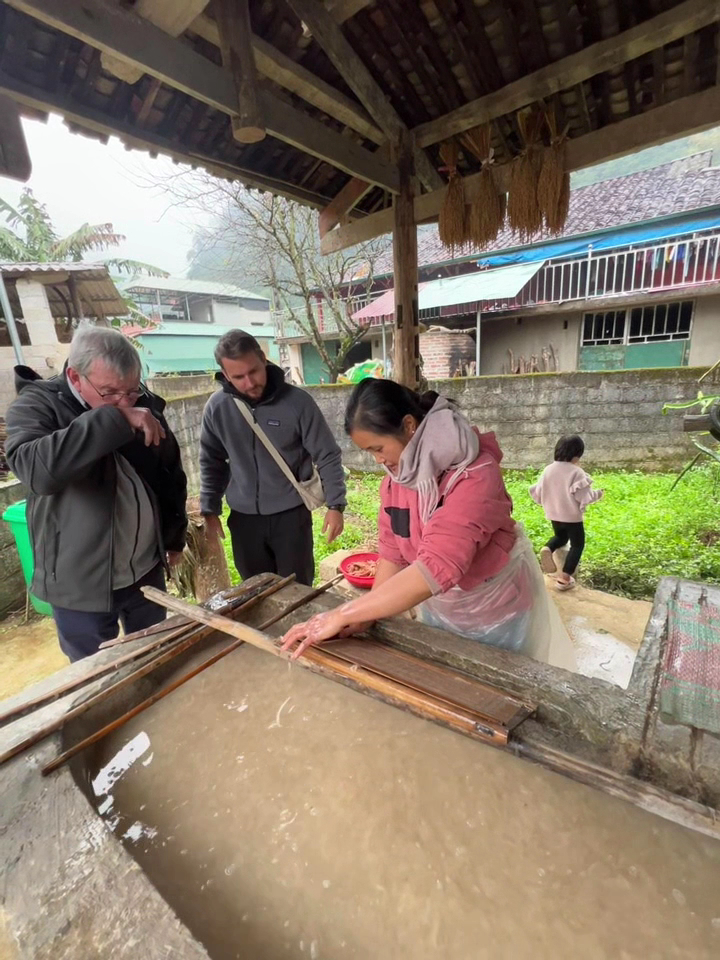
6. Forming the sheets: This is the most important step and is usually done by women. The craftswoman scoops pulp with a bamboo frame and spreads it evenly across the mold. Each mold forms one sheet of paper.
7. Pressing and drying: The wet sheets are stacked and pressed under heavy stones for about two hours to remove excess water. Each sheet is then pasted onto an earthen wall, where the Cao Bang sun and breeze finish the job.
When you see a wall covered in ivory-white sheets drying in the sun, you’ll understand why do paper is known as “the paper that preserves the soul of the mountains.”
The Artisans Keeping the Tradition Alive
Artisan Nong Thi Kinh learned to make paper at 15 and has practiced the craft for more than 36 years. When she married into her husband’s family, she carried on their papermaking tradition. For her, making do paper is more than a craft; it is part of Nung An spiritual life.
Ms. Nong Thi Cham, another longtime paper-maker, says no one knows when the craft began. She only remembers following her grandmother and mother into the forest as a child to gather tree bark, then soaking, boiling and pounding it into paper pulp. The craft requires little capital and does not pollute the environment.
From Local Markets to the World
Once made mainly for religious ceremonies and sold at local markets, Dia Tren handmade paper is finding a new purpose. In 2024, at the 8th Asia-Pacific Geoparks Network Symposium (APGN-8), held in Cao Bang, Dia Tren handmade paper and Phia Thap incense were selected as gifts for delegates and distinguished guests from Vietnam and abroad.
In 2025, the Vietnam Record Association featured Dia Tren paper-making village on its list of 100 outstanding century-old traditional craft villages in Vietnam.
Experiences in the Paper-Making Village
See how paper is made: Watch every step, from soaking the bark and pounding it into pulp to forming and drying the sheets.
Make your own paper: Try scooping pulp onto a mould and forming a sheet with guidance from a local artisan. You’ll see just how much skill it takes to make a smooth, even sheet.
Photograph the paper-covered walls: Earthen walls lined with sheets drying in the sun make a wonderfully unusual backdrop.
Learn about Nung An culture: Hear how handmade paper is used in one-month celebrations, weddings, coming-of-age ceremonies and ancestral worship.
Buy paper as a souvenir: A set of handmade paper makes a meaningful gift for calligraphy and Han Nom enthusiasts or anyone who collects traditional craft products.
When to Visit
- February to July: The season for stripping bark from may sla trees, when the village is busy preparing materials.
- On dry, sunny days: More sheets are laid out to dry on the walls, making this the village’s most picturesque time.
- Before Tet: Demand for paper rises, and more households are busy making it.
Add Quang Uyen to Your Itinerary
- Phia Thap Incense Village: A century-old incense-making village of the Nung An people in the same commune.
- Pha Hung viewpoint: Take in panoramic views of the valley and incense village from the mountain.
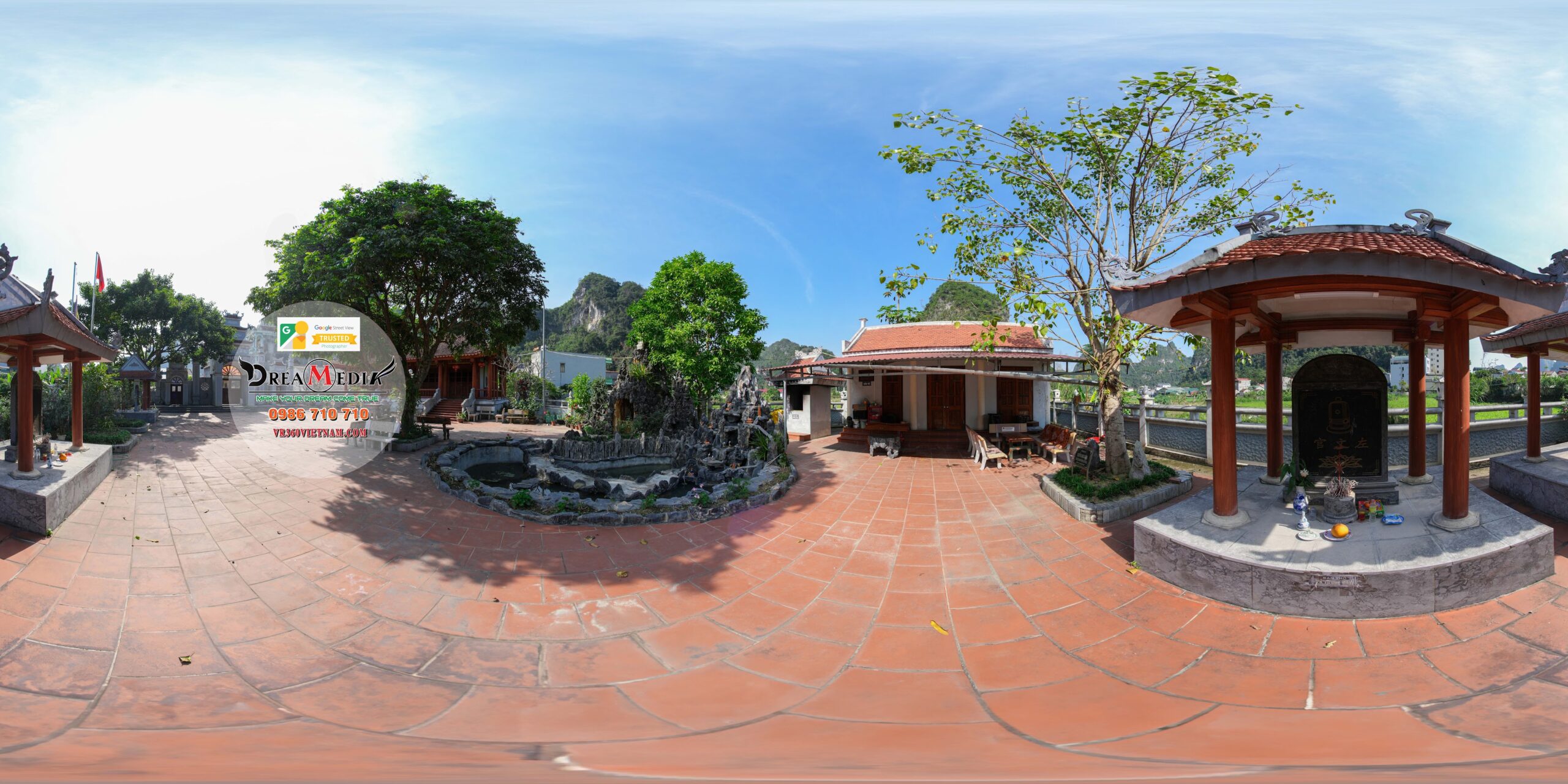
- Bach Linh Shrine and Nung Tri Cao Temple: A historic complex in the Quang Uyen area.
Visitor Tips
- Contact the village in advance if you’d like to try making paper, as production follows the seasons and the agricultural calendar.
- Respect the work areas: Don’t touch sheets left to dry, moulds or pulp troughs without permission.
- Ask before taking photos of residents or entering their homes.
- Support local artisans by buying their products in the village.
A Final Word
Each sheet of Dia Tren handmade paper carries the story of forest bark, slaked lime, cool streams and the mountain climate, shaped by the diligent hands of the Nung An people. Even in the age of machine-made paper, these humble sheets continue to be made quietly, preserving the memories and beliefs of an entire community. When you visit Quang Uyen, stop by Dia Tren, listen to the rhythmic pounding of the pulp and make a sheet of paper yourself. It will be the most special souvenir you bring home from Cao Bang.